GitHub
Tarantogas-Simulacra
Hierarchical multi-agent orchestration framework built on top of Claude Code — 5 agent tiers (research, planning, building, review, approval), file-based coordination with atomic writes, and a full 9-stage quality pipeline. Includes behavioral drift monitoring grounded in Anthropic research on LLM persona stabilization.
TypeScript
Multi-Agent
AI
Claude Code
Overview
A hierarchical multi-agent orchestration system built on Claude Code. Five agent tiers coordinate through atomic file writes — no external message queue. A deterministic TypeScript orchestrator owns all state transitions while AI agents handle research, planning, implementation, and review.
The system includes behavioral drift monitoring grounded in Anthropic research and a knowledge accumulation mechanism called the Compound step. Drift detection uses cosine similarity against baseline embeddings to catch when agents deviate from their role definitions, while the Compound step captures discoveries from every completed task into a collective knowledge base that persists across agent lifetimes.
Screenshots
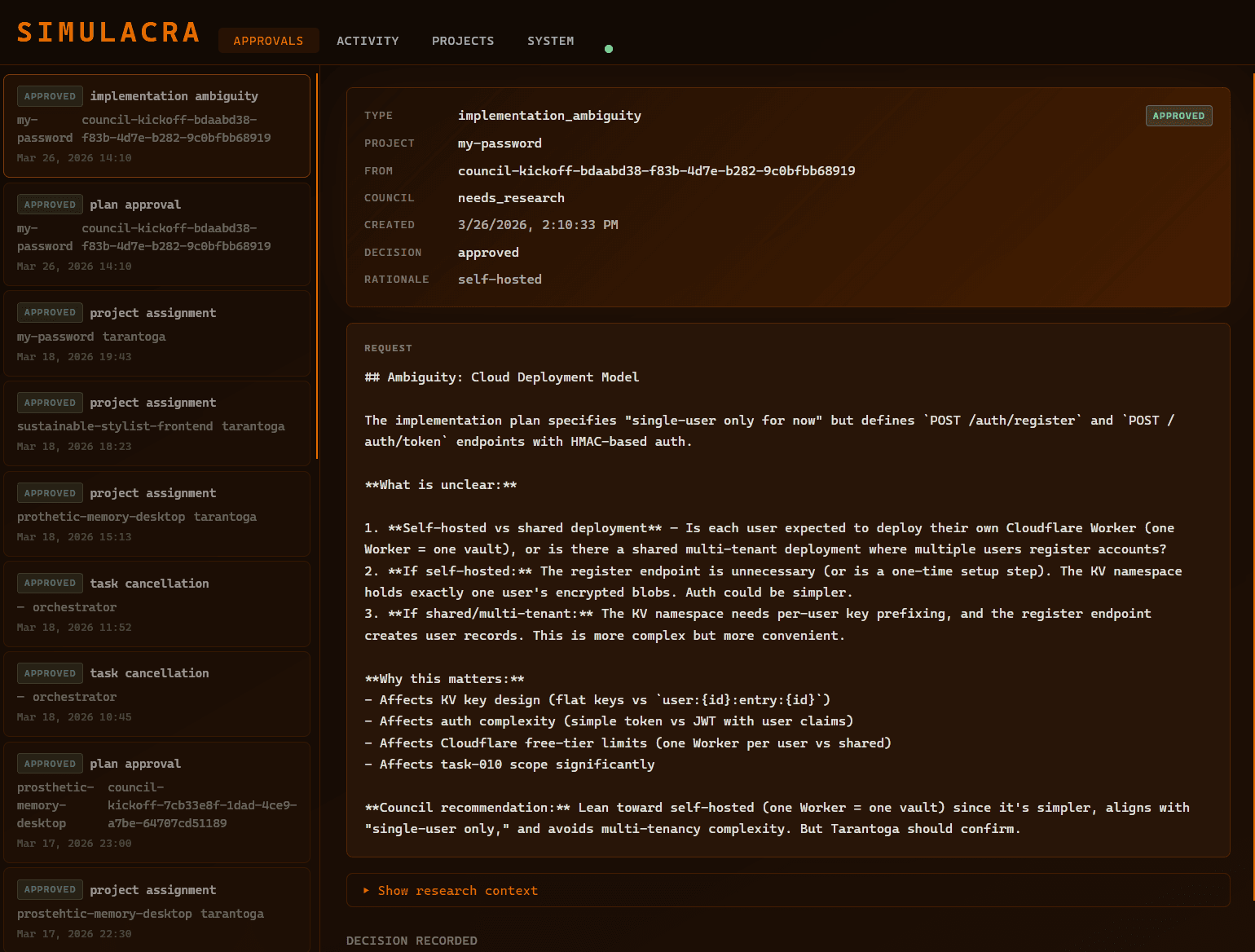
Council Approvals — Research Context & Decision Rationale
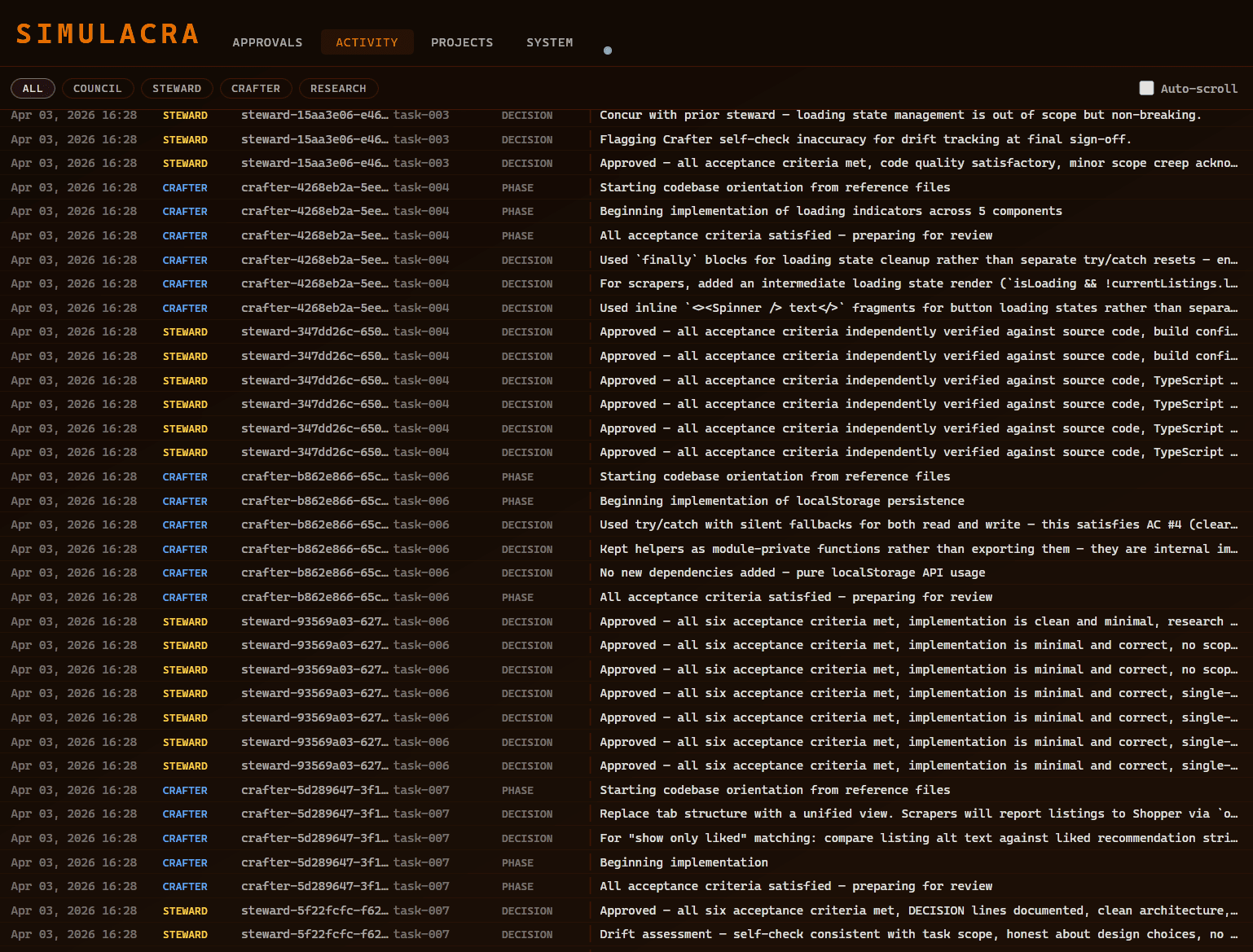
Activity Log — Real-time Agent Events
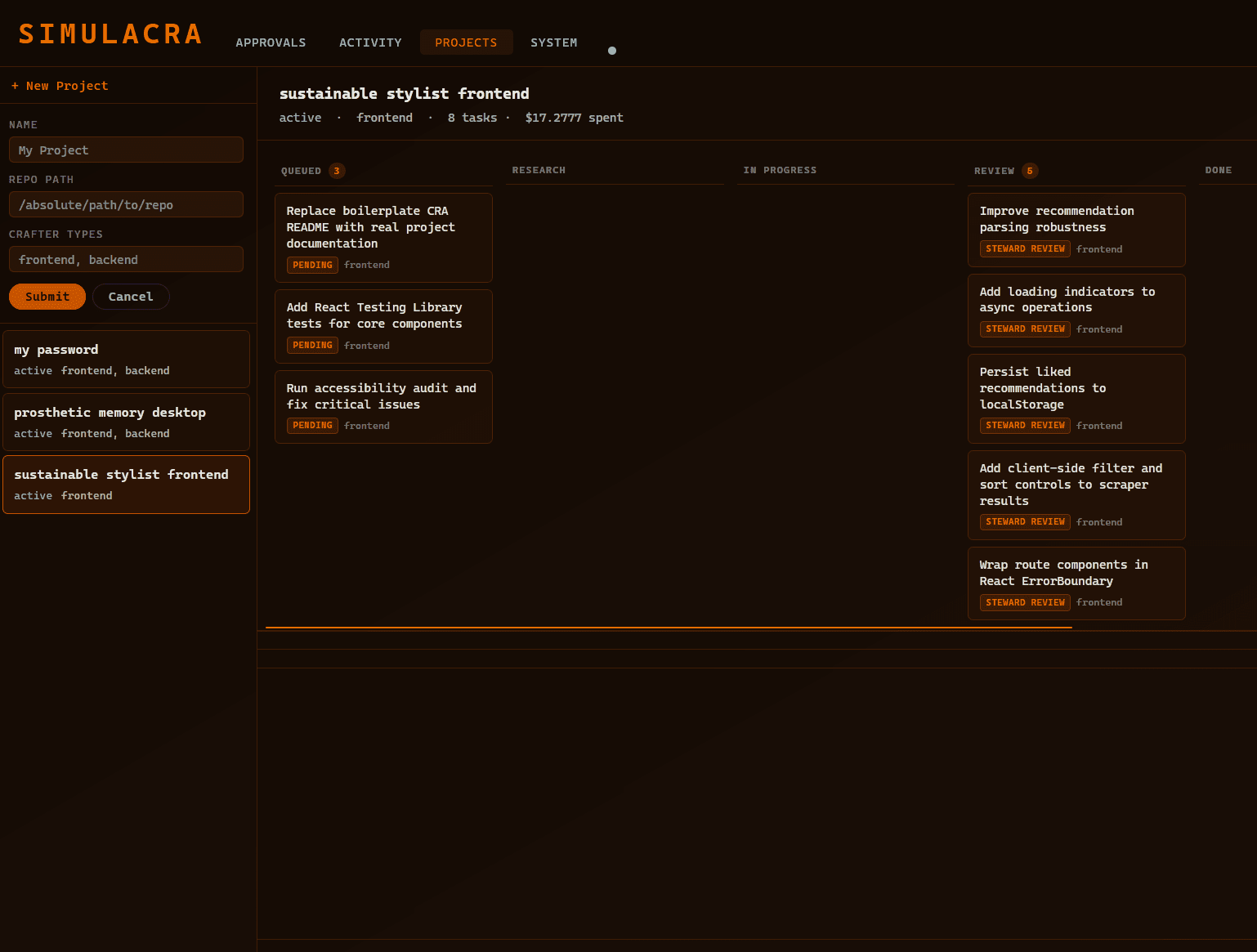
Project Management — Task Breakdown
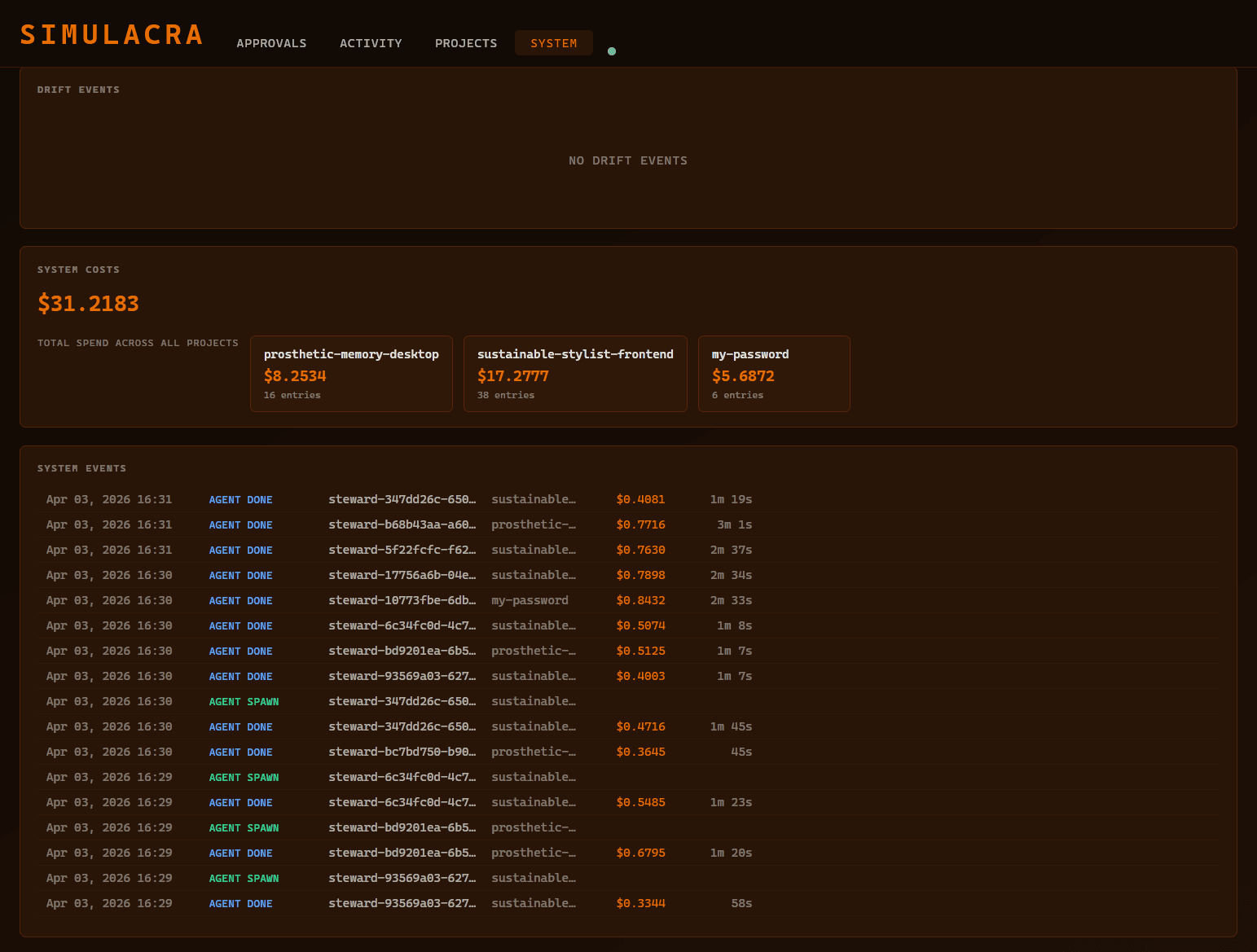
System Dashboard — Drift Events & Cost Tracking
Architecture
┌──────────────────────────────────────────────┐
│ TARANTOGA (HUMAN) │
│ Scope · Git · Novel Decisions │
└──────────────────┬───────────────────────────┘
│
┌──────────────────┴───────────────────────────┐
│ THE COUNCIL │
│ Plans · Peer-Reviews · Compound │
└────┬─────────────────────────────┬───────────────┘
│ │
┌────┴───────────┐ ┌────────────┴───────────┐
│ RESEARCH │ │ STEWARDS │
│ Knowledge │ │ Quality Gate · │
│ Gathering │ │ Drift Review │
└────────────────┘ └────────────┬───────────┘
│
┌───────────────┴───────────┐
│ CRAFTERS │
│ Implementation │
│ MCP-Sandboxed │
└───────────────────────────┘
File-based coordination with atomic writes. No external message queue — the TypeScript orchestrator owns all state transitions.
Quality Pipeline
1
Crafter Implements
Builder agents write code within MCP-enforced sandboxes. Tier 1 drift self-checks run every 8 tool uses.
2
Steward Reviews
Quality gate evaluates code quality, security, architecture, and acceptance criteria. Runs DriftMonitor report.
3
Crafter Revises
Numbered, specific, actionable revision requests. Crafter addresses each point.
4
Steward Final Sign-off
Tier 2 formal drift assessment. If drift detected: pre-decommission interview, knowledge base capture, restart.
5
Compound Step
The Knowledge Heartbeat. Structured interview captures discoveries for the collective knowledge base.
6
Council Review
Council author independently reviews the completed work against plan and standards.
7
Council Peer Review
Second Council member reviews. Tarantoga receives finished code with handoff note.
Drift Monitoring
Tier 1: Automated Self-Assessment
Every N tool uses, agents answer probe questions from their role definition. Cosine similarity against baseline embeddings runs locally and offline via all-MiniLM-L6-v2.
< 0.2
Nominal
0.2 – 0.4
Monitor
0.4 – 0.6
Reinject persona anchor
≥ 0.6
Halt and escalate
Tier 2: Steward-Led Review
Before the Compound step, the Steward reviews qualitative patterns alongside the DriftMonitor report. Decisions are never made in isolation.
If uncertain: escalation chain runs through a second Steward, then Council, then Tarantoga. No single agent can unilaterally decommission another.
If drifted: pre-decommission interview captures what the agent learned, anonymized knowledge is merged into the base, the agent is decommissioned, and a fresh instance is started.
Stack
TypeScript
Node.js
Claude API
Chokidar
Zod
Xenova Transformers
Express
WebSocket
Vitest